
Acromart
AAC Blocks vs Red Bricks Comparison for House Construction in India | Acromart Building Materials Marketplace
Masonry Materials & Building Blocks

AAC Blocks vs Red Bricks: Which is Better for House Construction in India?

Acromart Team·23 June 2026·1 min read

AAC Blocks vs Red Bricks: Which is Better for House Construction in India?

Choosing the right wall construction material is one of the most important decisions in any building project. For decades, red bricks have been the preferred choice for residential and commercial construction in India. However, modern construction practices are increasingly adopting AAC (Autoclaved Aerated Concrete) blocks due to their lightweight structure, thermal efficiency, and faster construction capabilities.

Builders, architects, contractors, and homeowners often ask the same question: AAC Blocks vs Red Bricks – which is better?

The answer depends on several factors including project budget, structural requirements, energy efficiency goals, and construction timelines.

This comprehensive guide from Acromart compares AAC blocks and red bricks across all major performance parameters to help you make an informed decision.

What Are AAC Blocks?

AAC (Autoclaved Aerated Concrete) blocks are lightweight precast building materials manufactured using:

  • Cement
  • Fly Ash
  • Lime
  • Gypsum
  • Aluminum Powder
  • Water

The material undergoes high-pressure steam curing inside autoclaves, creating millions of microscopic air pockets.

Benefits of AAC Blocks

  • Lightweight
  • High thermal insulation
  • Better sound insulation
  • Faster construction
  • Fire resistance
  • Environmentally friendly
  • Reduced structural load

What Are Red Bricks?

Red bricks are traditional clay-based masonry units manufactured by molding and firing natural clay in kilns.

They have been used in Indian construction for centuries.

Benefits of Red Bricks

  • High compressive strength
  • Easy availability
  • Proven durability
  • Familiar construction techniques
  • Good load-bearing capacity

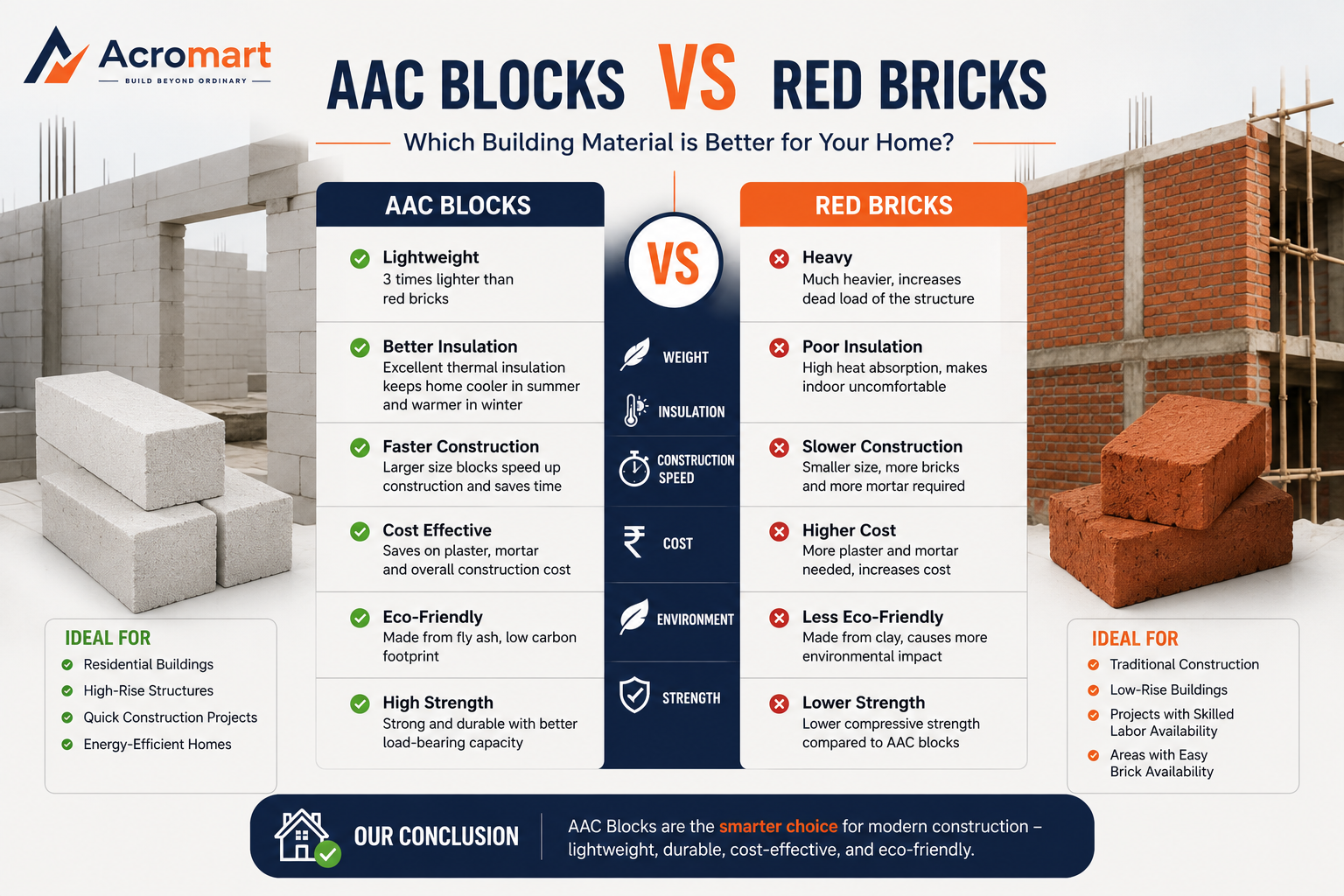
AAC Blocks vs Red Bricks: Detailed Comparison

1. Weight

AAC Blocks

AAC blocks are approximately three times lighter than traditional clay bricks.

Average Density:

550–650 kg/m³

Red Bricks

Red bricks are significantly heavier.

Average Density:

1800–2000 kg/m³

Winner: AAC Blocks

The reduced weight lowers structural load and steel consumption.

2. Construction Speed

AAC blocks are much larger than conventional bricks.

One AAC block can replace several bricks.

AAC Blocks

  • Faster installation
  • Reduced labor requirement
  • Quicker project completion

Red Bricks

  • More units required
  • Increased masonry time

Winner: AAC Blocks

3. Thermal Insulation

Thermal insulation helps reduce indoor temperatures and energy consumption.

AAC Blocks

Air pockets provide excellent insulation.

Benefits:

  • Cooler interiors
  • Reduced air conditioning costs
  • Improved energy efficiency

Red Bricks

Moderate insulation performance.

Winner: AAC Blocks

4. Sound Insulation

Noise reduction is important in urban environments.

AAC Blocks

Excellent acoustic performance.

Red Bricks

Moderate sound insulation.

Winner: AAC Blocks

5. Fire Resistance

AAC Blocks

Can withstand fire exposure for several hours.

Red Bricks

Fire resistant but less effective than AAC blocks.

Winner: AAC Blocks

6. Strength

AAC Blocks

Compressive Strength:

3–5 N/mm²

Red Bricks

Compressive Strength:

3.5–10 N/mm²

Winner: Red Bricks

Traditional bricks generally offer higher compressive strength.

7. Water Absorption

AAC Blocks

Moderate water absorption.

Proper waterproofing is recommended.

Red Bricks

Higher water absorption.

Can lead to dampness issues if not treated properly.

Winner: AAC Blocks

8. Cost Comparison

Initial material cost may vary by region.

AAC Blocks

Higher unit cost but lower labor and mortar requirements.

Red Bricks

Lower unit cost but increased labor and mortar consumption.

Winner: Depends on project scale.

Large projects often find AAC blocks more economical overall.

9. Sustainability

AAC Blocks

Manufactured using industrial by-products such as fly ash.

Lower environmental impact.

Red Bricks

Require clay extraction and kiln firing.

Higher environmental footprint.

Winner: AAC Blocks

Quick Comparison Table

ParameterAAC BlocksRed Bricks
WeightExcellentModerate
Thermal InsulationExcellentAverage
Sound InsulationExcellentModerate
Fire ResistanceExcellentGood
Construction SpeedExcellentModerate
SustainabilityExcellentLow
StrengthGoodExcellent
Water AbsorptionBetterHigher
Energy EfficiencyExcellentModerate

When Should You Choose AAC Blocks?

AAC blocks are ideal for:

  • Modern residential projects
  • Apartments
  • Commercial buildings
  • High-rise construction
  • Green buildings
  • Energy-efficient structures

When Should You Choose Red Bricks?

Red bricks may be suitable for:

  • Traditional construction
  • Load-bearing walls
  • Rural projects
  • Small residential buildings

Why Builders Are Switching to AAC Blocks

The Indian construction industry is rapidly adopting AAC blocks because they:

  • Reduce structural load
  • Lower steel consumption
  • Improve energy efficiency
  • Accelerate project timelines
  • Support sustainable construction practices

Many modern residential and commercial projects now prefer AAC blocks over conventional bricks.

How Acromart Helps Source Building Materials

Acromart is India's growing building materials marketplace that connects buyers with suppliers across the country.

Through Acromart, builders and contractors can source:

  • AAC Blocks
  • Cement
  • TMT Bars
  • Bricks
  • Tiles
  • Plumbing Products
  • Electrical Materials
  • Roofing Products

Visit www.acromarts.com to explore construction materials and supplier solutions across India.

Frequently Asked Questions

Are AAC blocks stronger than red bricks?

Red bricks generally have higher compressive strength, but AAC blocks provide sufficient strength for most residential and commercial buildings.

Do AAC blocks reduce construction costs?

Yes. AAC blocks reduce labor costs, mortar usage, and structural steel requirements.

Which material offers better thermal insulation?

AAC blocks provide significantly better thermal insulation.

Are AAC blocks eco-friendly?

Yes. AAC blocks are manufactured using sustainable materials and industrial by-products.

Which is better for modern construction?

AAC blocks are increasingly preferred for modern residential and commercial projects due to their lightweight structure and energy efficiency.

Conclusion

The AAC Blocks vs Red Bricks debate ultimately depends on project requirements. While red bricks remain a trusted traditional material, AAC blocks offer numerous advantages including lower weight, faster construction, better insulation, improved sustainability, and enhanced energy efficiency.

For most modern residential and commercial projects, AAC blocks provide a compelling alternative that supports faster and smarter construction.

To source AAC blocks, bricks, cement, steel, and other building materials from trusted suppliers across India, visit www.acromarts.com and discover a smarter way to procure construction materials.

Need these materials for your project?

Shop on Acromart →
Acromart Team

Elfinic Commerce Pvt Ltd

Learn more about us →

Share this article: